
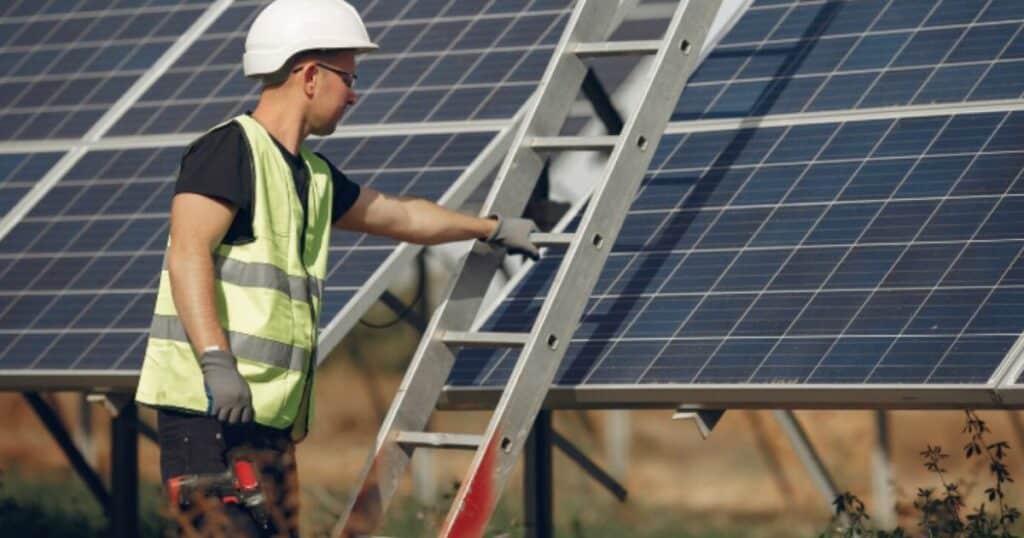
An industrial solar plant is a strategic investment that must be kept operational at peak performance throughout its lifetime. Regular maintenance not only prevents production losses, but also reduces the risk of costly breakdowns, ensures regulatory compliance and extends the service life of all system components. This checklist serves as a practical guide for technical managers, maintenance managers and industrial operators.
General visual inspection
- Verify the physical condition of the photovoltaic modules: breaks, cracks, stains or discoloration.
- Check for accumulation of leaves, dust, soot or droppings.
- Check support structures: check anchorages, bolts, rust and stability.
- Observe if there are new shadows (trees, constructions) that may affect production.
Solar panel cleaning
- Clean with demineralized water and soft brushes.
- Recommended frequency: every 6 months or more if there is a high accumulation of dirt (agricultural, industrial or coastal areas).
- Avoid abrasive products or non-specific chemicals.
- Before and after photographic record for historical control.
Review of wiring and connections
- Inspect for loose connections, frayed wires, chafing or abrasions.
- Check junction boxes, terminals, terminals and electrical protections.
- Check continuity and insulation resistance with professional instruments.
Testing of solar inverters
- Review error messages, failure logs or disconnections.
- Confirm correct operation of internal protections.
- Evaluate operating temperatures, abnormal noise and inverter efficiency.
Battery monitoring (if applicable)
- Visual inspection of terminals, sulfation, swelling or electrolyte leakage.
- Checking the state of charge, recorded cycles and management system (BMS) parameters.
- Verify installation in an area free of humidity and extreme temperatures.
Verification of the structure and support system
- Annual retightening of bolts and nuts.
- Verification of displacements, corrosion or soil settlement.
- Application of antioxidant treatments if necessary.
- Visual inspection of critical fasteners in high wind areas.
Production monitoring and predictive diagnostics
- Compare actual production with expected or simulated historical values.
- Detect unexplained losses as a sign of possible hidden faults.
- Use SCADA platforms or monitoring software for automatic alerts.
- Incorporate tools such as thermography or IV-curve measurement to anticipate failures.
Regulatory compliance and traceability
- Detailed maintenance record: dates, tasks, responsible parties and findings.
- Facilitates internal audits, ISO 14001 certifications and compliance with legal requirements.
- It provides value in the face of energy quality inspections or ESG managers.
Recommended frequency of checklist
- Complete overhaul at least once a year.
- Cleaning every 6 months (or 3-4 months in critical areas).
- Inverter and wiring revision every 6-12 months.
- Monthly production tracking with automatic alerts.
Business benefits of professional maintenance
- Avoids production losses of up to 25% due to dirt or undetected faults.
- Increases the useful life of the equipment.
- Reduces unexpected costs and plant downtime.
- Reinforces the industrial ESG strategy.
- Provides technical and legal security.
Want to make sure your plant performs at its best? Our technical team performs these inspections with professional instruments, certified protocols and digital record of all actions. We offer industrial maintenance plans adapted by type of plant and environment.
Request a technical review or contract our industrial maintenance plan with guaranteed production.