
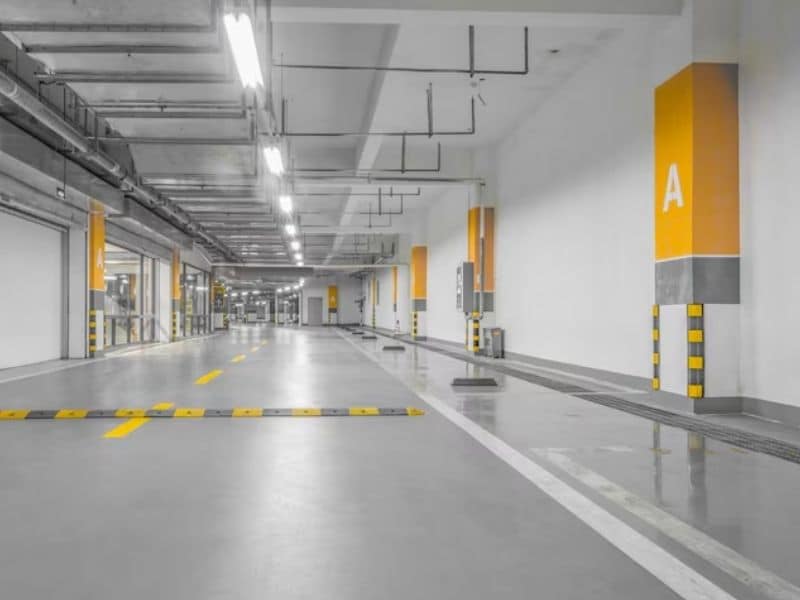
You can install an EV charger in your communal garage parking space without a vote at the residents’ meeting. Article 17.5 of Spain’s Horizontal Property Law guarantees this right. You only need to notify the building president or manager in writing 30 days in advance.
This guide covers the regulations updated for 2026, a free letter template to notify your community, and all the technical and legal steps to complete the installation correctly.
Can your homeowners association block your EV charger installation in a communal garage?
No. The homeowners association cannot block you from installing an EV charger in your private parking space. This right is protected by Article 17.5 of the Horizontal Property Law and does not require a vote or approval from the residents’ meeting.
The community could only object in three very specific situations:
- The installation affects structural elements of the building.
- The wiring compromises the safety of the shared electrical installation.
- The parking space is not individually assigned or is shared on a rotational basis.
Outside these cases, any refusal by the residents’ meeting has no legal basis.
What if the community does not reply?
After 30 days from confirmed receipt of your written notice, you can start the installation. The community’s silence does not suspend your right.
How to install an EV charger in a communal garage in Spain: legal steps
Step 1 — Confirm your parking space is individually assigned
Check the property deeds or bylaws to confirm the space is privately owned. If it is shared or rotational, you will need a formal vote at the residents’ meeting.
Step 2 — Request a technical survey
A certified electrician must assess the distance from your meter to the parking space, the building’s electrical capacity, and whether you need dynamic load balancing or a new independent supply.
Step 3 — Send written notice to the building manager
Notify the building president or manager in writing. This is not a permission request — it is a mandatory informational notice. Always send it by a trackable method: registered mail with delivery confirmation, a burofax, or an email with read receipt. Keep the proof.
The letter must include:
- Your details as the owner and your parking space number.
- A description of the equipment to be installed and its power rating.
- The name of the certified electrical installer.
- An explicit reference to Article 17.5 of the Horizontal Property Law.
- Your commitment to cover all costs.
Step 4 — Wait 30 days
After 30 days from confirmed receipt, you can start work even if the community has not responded or has expressed disagreement.
Step 5 — Install following ITC-BT-52 regulations
The certified electrician carries out the work ensuring four mandatory elements under ITC-BT-52: a dedicated electrical line, safety protections (type B differential), a certified wallbox, and intelligent power management.
Step 6 — Obtain the Electrical Installation Certificate (CIE)
On completion, the electrician issues the CIE. Without this document the installation is not legally compliant and your insurance may not cover incidents. Keep it with your invoice and the equipment data sheet.
ITC-BT-52 regulation: mandatory technical requirements for 2026
Installing an EV charger in a communal garage is governed by three regulations:
- Article 17.5 of the Horizontal Property Law: the owner’s right to install without a residents’ meeting vote.
- ITC-BT-52 of the Low Voltage Electrotechnical Regulations: the mandatory technical requirements for the installation.
- Royal Decree 1053/2014: the minimum charging infrastructure for new buildings.
1. Dedicated electrical line
The cable must run directly from your meter to the parking space, with no intermediate branches shared with other circuits.
2. Safety protections
A magnetothermal circuit breaker and a type B differential are mandatory, specifically designed for EV charging installations. The type B differential protects against direct current leaks, which is critical for this type of equipment.
3. Certified charging point (Wallbox)
Regulations do not allow a standard domestic socket as a permanent daily charging solution. The equipment must be certified and allow intelligent power management.
4. Electrical Installation Certificate (CIE)
On completion, the certified electrician must issue the CIE. Without this document the installation is not legally compliant.
Can I use a standard plug socket in my communal garage parking space?
Yes, it is legal but with important conditions. ITC-BT-52 allows standard domestic sockets (Schuko) provided they have their own circuit breaker, differential and surge protection, and the installation is notified to the community in advance.
| Schuko socket | Wallbox | |
|---|---|---|
| Installation cost | Lower | Medium-high |
| Charging speed | Slow (12-15 h) | Fast (4-8 h) |
| Safety | Lower | Higher |
| Off-peak scheduling | No | Yes |
| Recommended for | Plug-in hybrids | Pure electric vehicles |
For a pure electric vehicle charged daily, a standard socket should be a temporary solution only. For regular use, a certified smart charger is strongly recommended.
How much does it cost to install an EV charger in a communal garage in Spain?
| Installation type | Approximate cost |
|---|---|
| Simple installation (short cable run) | €800 – €1,200 |
| Medium installation (long cable run) | €1,500 – €2,500 |
| New independent supply | €2,500 – €4,000 |
Indicative prices including equipment and labour. Always request a quote after a site survey.
Are grants available in 2026?
Spain’s MOVES III plan covered up to 70-80% of costs depending on the municipality. Check the current status before starting work, as grants are usually processed after installation is complete.
Do I need to increase my contracted power?
Not necessarily. In many homes it is possible to install a charging point without changing the contracted power, especially with a charger that includes dynamic load balancing.
Dynamic load balancing automatically adjusts the charging power based on the home’s current consumption. When you are using the oven and air conditioning, the system reduces charging power. When household consumption drops, the charger automatically increases its intensity — avoiding tripped circuit breakers and, in many cases, eliminating the need to pay for additional contracted power.
Safety and liability: what happens if there is a fire?
A correctly installed charging point is no more dangerous than any other electrical appliance in the home. The risk comes from how the installation is done, not from the charger itself.
Incidents typically occur when:
- A standard domestic socket is used without a dedicated line.
- The installation lacks adequate differential protection.
- Work is carried out by uncertified individuals.
- Equipment is not certified.
If the installation meets technical regulations and has a CIE, liability is handled like any other private home installation. Insurers typically require a legally compliant installation, a certificate from a certified electrician, and certified equipment.
How to legalise an EV charger already installed?
- Contact a certified electrician to check that the existing installation meets ITC-BT-52.
- Obtain the Electrical Installation Certificate (CIE).
- Register the installation with the regional authority if required in your area.
- Notify your homeowners community if you did not do so before installation.
Whatever your case is, at Fotovol we analyze the conditions of your home or company, prepare the technical study and manage the entire process: from the application for grants to the implementation. Ask for a free quote and electrify your garagewith total guarantee.
Frequently asked questions about EV chargers in communal garages in Spain
Can my homeowners association block my EV charger installation?
No. Article 17.5 of Spain’s Horizontal Property Law protects this right without requiring a residents’ meeting vote.
Do I need permission from the community to install an EV charger?
No. You only need to notify them. After 30 days from confirmed receipt, you can start installation even without a response.
What is the ITC-BT-52 regulation?
The technical instruction from Spain’s Low Voltage Electrotechnical Regulations covering mandatory requirements for EV charging installations: dedicated line, type B differential, certified charger and CIE.
Can I use a standard plug socket in my communal garage?
Yes, with conditions: it needs its own circuit breaker, differential and protection, and you must notify the community in advance. For daily charging of a pure electric vehicle, a certified wallbox is recommended.
How much does it cost to install an EV charger in a communal garage in Spain?
Between €800 and €1,200 for simple installations, €1,500–€2,500 for medium complexity, and €2,500–€4,000 for a new independent supply. Always request a quote after a site survey.
Is the Electrical Installation Certificate (CIE) mandatory?
Yes. Without it the installation is not legally compliant and insurance may not cover incidents.
What happens if the building manager does not reply to my notification?
After 30 days from confirmed receipt, you can start installation. The community’s silence does not suspend your right.