Necessary protections for solar panels: summary by component
| Area | Essential component | critical function |
|---|---|---|
| DC side | gPV fuses (1000 V) | Prevent fires caused by reverse current |
| DC side | SPD Type 2 | Protect the inverter from lightning strikes |
| DC side | DC Disconnector | Allow safe maintenance |
| AC side | Class A Differential (SI) | Avoid harmonic triggering |
| AC side | Circuit Breaker Curve C | Short circuit protection |
| AC side | VGA (permanent overvoltages) | Protecting equipment against network failures |
A legal photovoltaic installation in Spain must incorporate specific protections in direct current (DC) and alternating current (AC), in accordance with the REBT and ITC-BT-40.
In direct current (DC):
- gPV fuses sized according to the short-circuit current ( I sc )
- Load break switch suitable for open circuit voltage ( V oc )
- Surge protector (SPD) Type 2 1000 V or 1500 V (or Type 1+2 depending on risk)
In alternating current (AC):
- Circuit breaker with C curve and suitable breaking capacity (6 kA or 10 kA)
- Type A or B residual current device, preferably with superimmunization
- Protection against transient and permanent overvoltages (VGA) according to ITC-BT-23
Without these protections, the installation does not comply with regulations and cannot be properly legalized.
Why protective features are not an “extra”
Installing panels without adequate protection is like driving a car without brakes: it can work for months… until a storm or a voltage spike destroys the most expensive component of the system: the inverter.
In real-world installations, failures don’t usually originate from the panel. They originate from:
- Incorrectly sized fuses
- SPDs chosen without checking the actual Voc
- Differentials that trip due to harmonics
- DC boxes without protection coordination
Protective measures don’t increase the cost of an installation. They protect it. And, above all, they make it legal.
Applicable Spanish regulations
Before delving into specific components, it’s important to understand the legal framework. Protections in photovoltaic systems are governed by:
- REBT (Low Voltage Electrotechnical Regulations)
- ITC-BT-40 (low voltage generating installations)
- ITC-BT-23 (overvoltage protection)
- UNE-HD 60364-7-712 (photovoltaic installations)
- UNE-HD 61643-31 (SPD in direct current)
The regulations not only require the installation of devices: they require them to be correctly sized according to I sc , V oc and exposure level.
If you are considering a new installation, it is essential that the project includes from the beginning the design of the protection panel and the legalization in accordance with ITC-BT-40.
DC protections in photovoltaic solar systems
The DC side is the most electrically demanding. It operates at high direct voltage (1000 V or 1500 V in large installations) and lacks zero crossing like the AC side. Here, the strings, the combiner box, and the inverter input must be protected.
gPV fuses per string
The fuses must be specifically designed for photovoltaics (gPV type). They are sized taking into account the short-circuit current ( Isc ), the number of parallel strings, and the maximum system voltage. Their main function is to prevent fires caused by reverse currents between strings.
DC load break switch
The disconnect switch allows the solar array to be isolated for maintenance or emergency situations. It must withstand the maximum operating voltage (Voc) , allow for load shedding, and be clearly labeled. An undersized disconnect switch can generate a sustained electrical arc.
DC protection box for photovoltaics: what it includes and why it is critical
The DC protection box contains:
- gPV fuses
- SPD in DC
- Main disconnector
- Ground
In industrial installations, it can include string monitoring to detect performance losses. It is one of the most critical elements of the system.
Surge protection in photovoltaic installations (SPD)
The SPD protects the inverter against overvoltages induced by lightning strikes or network switching operations.
Common types:
- Type 1 → direct lightning strike
- Type 2 → induced overvoltages (most common in homes)
- Type 3 → thin protection, as a complement
Type 2 is usually installed in residential properties. In solar parks, Type 1 + Type 2 coordination may be required.
A single nearby lightning strike without a surge protector can destroy the inverter and connected appliances. The cost of an external surge protector is a fraction of the cost of replacing the inverter.
AC protections in solar installations
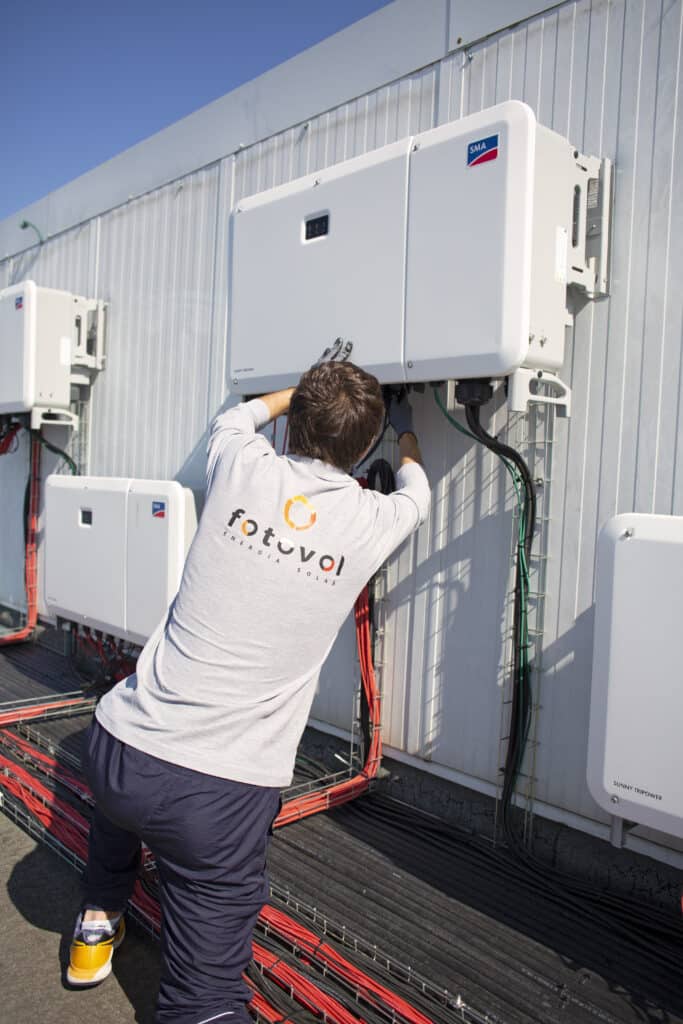
When the inverter converts direct current (DC) to alternating current (AC), the energy becomes part of the building’s electrical system. At this point, protective devices must guarantee both the safety of people and the integrity of the equipment.
Circuit breaker with C-curve
It protects against overloads and short circuits. In solar installations, a C-curve is commonly used due to its balance between sensitivity and peak tolerance. The breaking capacity must be verified: 6 kA or 10 kA depending on the available grid. If this is insufficient, the device may not properly interrupt a serious fault.
Residual current device (RCD)
It protects against indirect contact. Type A is suitable for most installations; Type B is required by the inverter. In professional practice, a highly immune differential circuit breaker is recommended to prevent harmonic tripping.
Permanent overvoltage protection (VGA)
In addition to transient overvoltages, Spanish regulations require the assessment of permanent overvoltages. These can be caused by neutral faults, network imbalances, or problems in the service connection. The main circuit breaker (MCB) with combined protection (VGA) disconnects the installation if the voltage exceeds regulatory limits. It is one of the most important protections on the AC side.
Safety in solar parks and large facilities
In solar parks, protection is not only electrical. It is also structural and equipotential. The following must be guaranteed:
- Grounding of metallic structures
- Electrical continuity between frames
- Metal trays connected to the grounding system
- Coordination and selectivity of protections
In high-power installations, maximum fault currents, coordination between Type 1 and Type 2 surge protection devices, and insulation monitoring systems are also analyzed. At this stage, the design requires specialized engineering.
Cable protection
The wiring must be Class II (double insulated), UV-resistant, and properly sized. It’s also advisable to avoid long parallel runs between DC and AC cables and to ground metallic conduits. An undersized cable doesn’t fail in the first year; it fails when the installation is under heavy load.
Properly designing the protection devices for a photovoltaic system isn’t about choosing the standard components. It’s about calculating the current ( Isc) , verifying the actual voltage ( Voc) , coordinating the power distribution panel (SPD), and ensuring sufficient breaking capacity. An error in the DC protection system can cost thousands of euros in a single voltage spike.
Health and safety plan for photovoltaic installations
Installing solar panels involves electrical work and, in many cases, tasks on roofs or at heights. For this reason, Spanish regulations require the application of specific occupational risk prevention measures to protect workers during the execution of the work.
The Health and Safety Plan is the document that adapts preventive measures to the actual conditions of each photovoltaic installation. It identifies the main risks: falls from heights, electrical contact, handling of loads, use of tools, and exposure to adverse weather conditions.
Common measures include the use of lifelines, fall arrest systems, personal protective equipment, work zone signage, and emergency response procedures. The plan also establishes the responsibilities of each participating company and defines coordination protocols when multiple teams are involved.
The correct application of these measures not only helps to comply with current regulations, but also contributes to ensuring a safe, efficient execution in accordance with the requirements demanded for the legalization of the photovoltaic installation.
Thinking about installing solar panels? At Fotovol, we design and install photovoltaic systems for homes and businesses, tailoring every project to the property’s actual energy needs. We manage the entire process, from the initial assessment and installation to legalisation and commissioning, ensuring a safe, efficient system that complies with current regulations.
Learn more about our residential solar panel installation services and commercial photovoltaic solutions.
Frequently asked questions about solar panel protection
What protections do solar panels need?
Solar panels require protection on two fronts. On the DC side: gPV fuses sized according to the I sc , load break switches, and a 1000 V Type 2 SPD. On the AC side: a C-curve circuit breaker, a super-immunized Class A residual current device (RCD), and VGA protection. All in accordance with the REBT, ITC-BT-40, and UNE-HD 60364-7-712.
What is a DC protection box in photovoltaics?
This assembly includes the gPV fuses per string, the DC SPD, the main disconnect switch, and the DC-side grounding connection. It is the most critical element of the solar array: it protects the inverter against reverse currents and overvoltages, and allows the system to be safely isolated for maintenance.
When is it mandatory to install a surge protector?
According to ITC-BT-23 of the REBT (Spanish Low Voltage Electrotechnical Regulations), its installation is mandatory if the risk of overvoltages could affect the safety of people or public services. In practice, almost all distribution companies require it to legalize the installation, since a single nearby lightning strike can destroy the inverter and household appliances.
What is the difference between AC and DC protection in an inverter?
DC protection operates between the panels and the inverter (protecting the equipment from voltage spikes in the solar array), while AC protection protects the home’s electrical system and the inverter itself from faults originating from the external power grid. It is vital that both systems are independent and coordinated so that a fault on one side does not compromise the safety of the other.
What if my inverter already has built-in protections?
Many modern inverters include internal varistors, but these are usually “sacrificial” and difficult to repair. Regulations and best practices always recommend an external surge protection box. This ensures that, in the event of an overvoltage, only an inexpensive cartridge of the external surge protection device (SPD) is damaged, and not the main electronic board of the inverter, which is much more expensive to repair.
What are the disadvantages of not using a super-immunized differential?
If you install a standard residual current device (RCD), you’ll experience unexpected tripping. Inverters generate natural leakage currents and harmonics that standard RCDs interpret as a safety fault, cutting off the power to your home unnecessarily. The super-immunized Class A RCD filters these signals, ensuring the system only trips when there is a real risk of electrocution.