
Combining aerothermal energy with photovoltaic solar panels is one of the most cost-effective decisions you can make if you want to reduce your energy bill and stop relying on gas. However, not all systems are well integrated, and not all installers know how to configure them to work together efficiently.
In this article we explain how the combination works, how much you can save, what those who already have it installed think, and what mistakes to avoid.
How does aerothermal heating with solar panels work?
Aerothermal energy is a heat pump that extracts thermal energy from the outside air to generate domestic hot water, heating, and cooling. Its efficiency is measured by the COP: a COP of 4 means that for every kW of electricity consumed, 4 kW of thermal energy are generated.
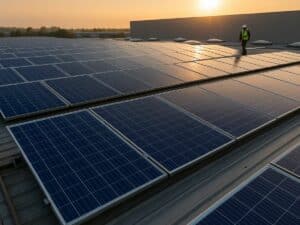
Photovoltaic solar panels generate electricity from the sun. The combination involves using that electricity, which in many cases would be surplus electricity fed into the grid, to directly power the heat pump.
The result is a system where free solar energy is converted into heat very efficiently. Instead of using 1 kW of solar energy to directly heat water (which would yield 1 kW of thermal energy), that same kW is used to power the heat pump, which converts it into 4 kW of thermal energy thanks to its high COP (Coefficient of Performance).
Does the air source heat pump connect directly to the solar panels?
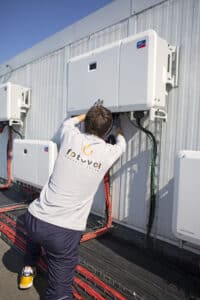
Not directly. Aerothermal systems operate on alternating current (AC), and solar panels produce direct current (DC), which the inverter converts to AC. The system is configured so that the heat pump activates first when there is solar production, using energy management systems, surplus relays, or intelligent control systems integrated into the inverter.
If you are considering installing solar panels to power your air source heat pump, our residential photovoltaic installation service will help you size the complete system from day one.
How many solar panels do I need to power a heat pump?
A domestic hot water heat pump consumes between 0.5 and 1.5 kW when operating. For underfloor heating, consumption can reach 3-6 kW depending on the unit’s power and the outside temperature.
| Use | Heat pump consumption | Recommended panels |
|---|---|---|
| ACS only (family of 3-4 people) | 0.5 – 1 kW | 3 – 5 panels (400W) |
| Domestic hot water + heating for an average home | 2 – 4 kW | 8 – 14 panels (400W) |
| Domestic hot water + heating + cooling | 3 – 6 kW | 12 – 20 panels (400W) |
These are indicative values. The actual sizing depends on the geographical location, the orientation of the panels, the insulation of the house, and the heat pump model.
What happens when there isn’t enough sun?
The system continues to function because the aerothermal system can consume electricity from the grid when there is insufficient solar production.
The difference compared to a system without solar panels is that during the months with the highest solar radiation, the heat pump’s electricity consumption is mostly covered by solar energy. In winter, the system draws more from the grid, but aerothermal energy is still much more efficient than any conventional gas or electric system.
With storage batteries, autonomy improves significantly, although the installation cost increases.
Aerothermal energy or solar panels: which to install first?
If your biggest expense is heating and hot water, start with an air source heat pump. It’s the system that has the greatest impact on your heating bill and can work perfectly well without solar panels.
If your biggest expense is general electricity: start with solar panels. You’ll reduce your entire home’s energy consumption from day one, and you can add heat pumps later.
Ideal for a new home or complete renovation: install both at the same time. Integration from the start allows for a more efficient design and avoids duplicate installation costs.
Aerothermal energy vs solar panels: it’s not a comparison, it’s a combination
Many searches present “aerothermal energy vs solar panels” as if they were mutually exclusive alternatives. They are not. They are complementary technologies that enhance each other.
| Aerothermal only | Solar panels only | Aerothermal + solar panels | |
|---|---|---|---|
| Savings on hot water | Up to 70% | Up to 60% (sunny months) | Up to 85-90% |
| Heating savings | Up to 70% | Limited | Up to 75% |
| Savings in general electricity | Not applicable | Up to 60-70% | Up to 70% |
| Initial investment | €5,000 – €10,000 | €5,000 – €10,000 | €10,000 – €18,000 |
| Return on investment | 5-8 years | 5-8 years | 6-9 years |
| Energy independence | Average | Average | High |
Advantages of combining aerothermal energy and solar panels
Maximum energy savings: Aerothermal systems can save up to 70% on domestic hot water and heating. Combined with solar thermal energy, these savings can exceed 80% on an annual basis.
Real self-consumption: solar energy that was previously fed into the grid at a low price is now used directly for heating and hot water, where it has the most value.
All-in-one system: heating, cooling and hot water with a single system powered by its own energy.
Gas independence: completely eliminates dependence on fossil fuels and their price fluctuations.
Access to subsidies: many autonomous communities offer aid for the joint installation of aerothermal and photovoltaic systems.
Things to consider before installing
Proper technical integration: the most critical point is configuring the system so that the heat pump is activated primarily with surplus solar energy, using energy management systems, surplus relays, or control systems integrated into the inverter. Without this configuration, the savings are significantly lower.
Avoid using an electric heating element: Heat pumps have an auxiliary electric heating element that, if activated frequently, increases energy consumption. A properly sized and configured unit should not require it.
Initial investment: the combination can cost between €10,000 and €18,000. It is recouped in 5 to 8 years depending on previous consumption and subsidies obtained.
Space: Space is needed for the outdoor unit of the heat pump, the DHW storage tank and the electrical control panel.
Performance in very cold climates: In areas with extreme winters, the efficiency of air source heat pumps decreases. Current models operate down to -25°C, but the COP drops at very low temperatures.
Real user reviews of heat pumps and solar panels
What they value most:
- The electricity bill drops drastically in the first months of use
- Hot water is free during the summer and practically free in spring and autumn
- Thermal comfort is improved compared to previous gas or electric systems.
- The peace of mind of not being dependent on gas price increases
They mention the following as points for improvement:
- The initial investment is high and the return is not always immediate.
- The initial setup requires an installer who is familiar with both systems
- In winter the bill goes up because the demand for heating is higher and there is less sun
- Some models are noisier than expected
Real-life example:
A family of four in a detached house in Girona with a Fronius inverter and a Panasonic Aquarea heat pump. Domestic hot water programmed to activate only with excess solar energy. Result: 100% free domestic hot water from March to October and a 65% reduction in total annual energy consumption.
Pure photovoltaic solar DHW vs aerothermal
| Photovoltaic DHW with water heater | Aerothermal heating with panels | |
|---|---|---|
| Initial investment | €800 – €2,000 | €8,000 – €15,000 |
| Efficiency (COP) | 1 | 3.5 – 5 |
| Winter performance | Low | High |
| Heater cover | No | Yeah |
| Cooling cover | No | Yeah |
| Return on investment | 1-3 years | 5-8 years |
If the goal is solely to use an air source heat pump for domestic hot water and the budget is limited, a surplus heat diverter is a viable option. If the goal is to also cover heating and cooling and maximize long-term savings, an air source heat pump with solar thermal panels is the most comprehensive solution.
Comparison of aerothermal systems for domestic hot water
| Make / Model | COP | ACS Volume | Working range | External noise | Approx. price |
|---|---|---|---|---|---|
| Panasonic Aquarea | 4.48 | 185 L | -20 ºC | 59 dB | €5,900 |
| Mitsubishi Ecodan | 4.8 | 200 L | -20 ºC | 58 dB | €6,500 |
| Vaillant aroTHERM Plus | 4.79 | 185 L | -25 ºC | 39 dB | €8,700 |
| Hitachi Yutaki S Combi | 4.6 | 220 L | -20 ºC | 54 dB | €6,200 |
| Daikin Altherma 3 | 4.6 | 180 L | -25 ºC | 62 dB | €6,600 |
How much you can save: a realistic estimate
| Concept | Before | With aerothermal heating + panels |
|---|---|---|
| ACS annual | 500 – 700 € | 50 – 150 € |
| Annual heating | €1,200 – €2,000 | €300 – €600 |
| General electricity | €1,000 – €1,500 | €300 – €600 |
| Estimated total | €2,700 – €4,200 | €650 – €1,350 |
Subsidies for aerothermal energy with solar panels
The combination of aerothermal and photovoltaic energy can benefit from several public aid programs that significantly reduce the initial investment.
Recovery Plan (PRTR): aid managed by the autonomous communities for renewable energy and energy efficiency installations. In some programs, joint installations receive a higher percentage of subsidy than each technology separately.
Income tax deductions: Many autonomous communities offer deductions for installing renewable energy systems. An energy efficiency certificate is required before and after the installation.
Municipal bonuses: some municipalities apply discounts on the IBI or ICIO for homes with renewable installations.
Check out all the available grants for aerothermal energy in 2026, including amounts, requirements and deadlines, in our complete guide to aerothermal energy grants .
Checklist for choosing well
- Hot water tank of more than 180 L for 4 people
- COP equal to or greater than 4.5
- External signal control for activation with solar surplus
- Operation with outside air down to at least -20°C
- Good sound insulation, especially if the outdoor unit is near bedrooms.
- Installer with experience in the integration of aerothermal and photovoltaic systems
- Energy manager or surplus relay to optimize self-consumption
Frequently Asked Questions about Aerothermal Energy with Solar Panels
Can I connect my existing heat pump to new solar panels?
Yes, provided the heat pump has an external signal input for priority activation. Most current models do. The process requires installing an energy manager or surplus relay that tells the heat pump when solar energy production is available.
How many panels do I need to cover the energy consumption of my heat pump?
It depends on the use. For domestic hot water only, 3 to 5 400W panels are usually sufficient. To also cover heating, you need between 8 and 14 panels. For a complete system with cooling, between 12 and 20 panels.
Is it better to install batteries as well?
Solar batteries improve autonomy and allow the use of stored solar energy when there is no sun. The cost increases by between €4,000 and €8,000. It makes more sense in homes with high nighttime energy consumption or in areas with limited access to the electrical grid.
What happens in winter when there is little sun?
Aerothermal systems draw electricity from the grid when solar production is insufficient. They remain significantly more efficient than conventional systems because their COP (Coefficient of Performance) multiplies the energy consumed by 3.5 to 5.