
Industrial photovoltaic self-consumption
Why industrial self-consumption works
-
High overlap with production: many processes consume during daylight hours.
-
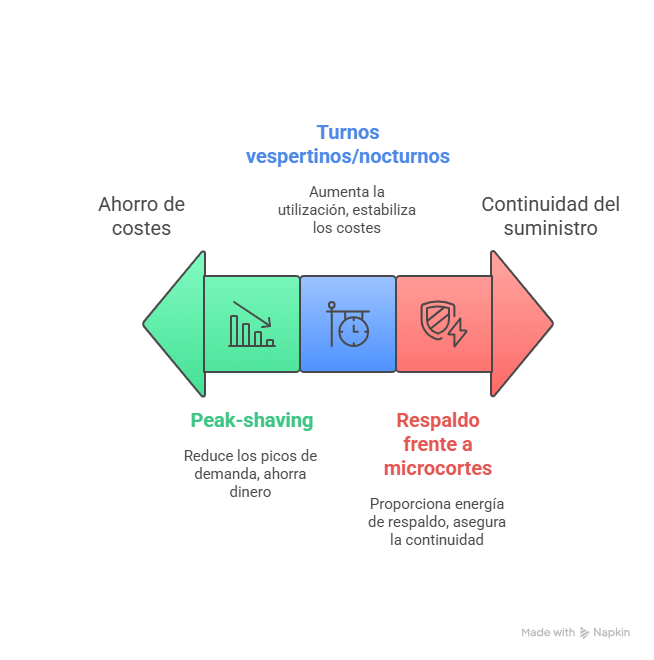
Expensive peaks: with battery and management we do peak-shaving to lower power in P1-P2.
-
Stable cost: your PV LCOE goes down and you de-index part of the energy cost.
-
Underutilized assets: roof or land = own energy and ESG image.
Modalities and when to choose each one
| Modality | When it fits | Practical note |
|---|---|---|
| No surplus (no overflow) | contract or network that does not support injection | fast-track procedures; avoid over-sizing |
| With surplus (compensation) | LV ≤ ~100 kW and daytime consumption | monetizes surplus; adjusts size |
| Sale of energy | >100 kW or HV | market representation |
| With batteries | expensive peaks on P1-P2; evening/night consumption | increase % useful and low contracted power |
PPA vs EPC (financing)
- PPAon-site (without investment): you pay per kWh cheaper than grid, 7-15 year contract; O&M included; purchase option.
- EPC (turnkey): own investment; typical amortization [fill in]-[fill in] years; maximum control of the asset.
At fotovol, we compare NPV/IRR in both scenarios and propose the one that leaves the least € on the table.
How much it costs and how much you save
| type of industry | typical power | % self-consumption without / with battery |
|---|---|---|
| light ship / logistics | 80-200 kWp | 45-65% / 65-85% |
| industrial cooling | 100-400 kWp | 40-65% / 65-90% |
| manufacturing with peaks (compressors, furnaces) | 150-500 kWp | 35-60% / 60-85% |
Example 1 – industry 300 kWp + ESS
- Consumption: 1,200 MWh/year – PV 300 kWp → production ≈ 480 MWh/year.
- Battery 250 kW / 500 kWh → peak-shaving 150 kW in P1-P2.
- Energy savings (55% auto): ~42-50 k€ /year
- Power savings: ~8-15 k€ /year
- Estimated total: ~50-65 k€ /year (with O&M and degradation modeled in NPV)
Example 2 – logistics 150 kWp without ESS
- Consumption: 450 MWh/year – production ≈ 240 MWh/year
- Self-consumption 60% + compensation 10% → ~22-28 k€ /year (depending on price and periods).
Industrial batteries? When yes
Legal and security
- REBT / ITC-BT-40: DC/AC protections, anti-islanding, SPD, selectivity, earths.
- OCA: initial and every 5 years when applicable (LV by power/use; HV always).
- Access and connection: metering points, compensation or sales contract, anti-pouring if applicable.
- Urban planning and structure: calculation, lifelines, handrails, civil works if canopies/terrain.
Industrial O&M
- 24/7 monitoring with alerts and KPIs: PR, % self-consumption, cut-off power.
- Programmed cleaning according to actual soiling, tightening and thermography.
- Response SLA and critical spare parts.
- Monthly reports with savings by periods and recommendations for improvement.
Grants and financing
Municipal subsidies (ibi/icio) and regional programs.
On-site PPA: no initial investment; you pay per kWh cheaper than the grid.
Turnkey EPC if you prefer to be owners from day 1.
- We combine subsidies and deductions to maximize ROI.
Our projects
Frequently Asked Questions
In a solar panel installation, battery yes or no?
We propose it when it provides profitable peak-shaving or increases a lot the useful % in evening/night shifts. The decision is based on your load curve and period pricing.
Compensation or sale of surplus?
Up to 100 kW in LV, simplified compensation is usually applied. Above and/or in HV, it is usually sale with representative. Even so, we size for self-consumption first.
How long does the project take?
From 3 to 10 weeks of work depending on size and civil works; legalization and, if applicable, OCA, go in parallel. We give you a schedule with milestones.
Can I reduce the contracted power?
Yes, with battery and management peaks are cut in P1-P2. We adjust power by periods and quantify the savings in €/kW-year.
What if my cover is no good?
We value the installation of canopies or solar gardens with fencing and CCTV. We also reinforce structure if necessary.