The energy transition is no longer just the domain of large utility companies. Thanks to the EU Clean Energy Package, any citizen, SME or local authority can now become a renewable energy producer and share it with their community.
In this context, two key legal figures have emerged:
- Renewable Energy Communities (RECs) — governed by EU Directive 2018/2001
- Citizen Energy Communities (CECs) — governed by EU Directive 2019/944
While both share the goal of democratising access to clean energy, they differ significantly in scope, participants and permitted activities. In this article we explain what a REC is, how it works, how it differs from a CEC, and how you can create one or join an existing one.
What is a Renewable Energy Community (REC)?
A Renewable Energy Community (REC) is a legal entity formed by natural persons, SMEs or local authorities who associate in an open and voluntary manner to develop local renewable energy projects.
Key characteristics
- Open and voluntary participation: any local citizen or SME can join or leave without discrimination.
- Democratic control: decisions are made collectively by the community members.
- Territorial proximity: installations must be located near the members or the municipality.
- Non-profit purpose: the goal is not financial profit but a positive environmental, social and economic impact.
- Renewables only: all energy managed must come from clean sources (solar, wind, biomass…).
Objectives
- Drive the energy transition by reducing CO₂ emissions.
- Democratise energy access: citizens move from being mere consumers to prosumers (producers and consumers at the same time).
- Generate direct savings on members’ electricity bills.
- Strengthen local development through sustainable projects.
Types of projects developed
- Collective self-consumption: generating electricity locally and sharing it among neighbours. This is the most common form of REC in Spain.
- Electric mobility: installation of shared charging points for electric vehicles.
- Efficiency and climate control: heat or cold networks for neighbourhood buildings using renewable sources.
- Shared storage: community batteries to optimise consumption and generation.
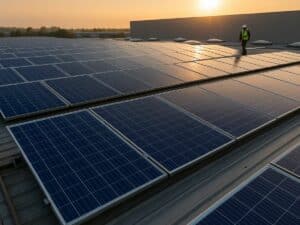
Practical example: a neighbourhood cooperative installs solar panels on the roof of a municipal sports centre and distributes the generated energy to 50 local families, reducing their electricity bill by 30% to 60%.
Differences Between REC and CEC
| Feature | REC | CEC |
|---|---|---|
| Regulation | EU Directive 2018/2001 | EU Directive 2019/944 |
| Energy type | Renewables only | Renewables and non-renewables |
| Geographic scope | Local, close to installations | No strict territorial restriction |
| Participants | Citizens, SMEs and local public bodies | Citizens, companies (without majority control) and public bodies |
| Activities | Production, storage, efficiency, mobility | Same, plus electricity distribution and supply |
| Purpose | Local impact, non-profit | Same with greater flexibility |
In summary: a REC is local and focused exclusively on renewables. A CEC is broader and more flexible, with energy activities that go beyond renewables and without such strict territorial restrictions.
REC and CEC Regulations in Spain
Spain has been progressively adapting EU directives into its national legislation. Key milestones:
| Regulation | Year | What it provides |
|---|---|---|
| RD 244/2019 | 2019 | Regulates collective self-consumption, the basis of many RECs |
| RD-Law 23/2020 | 2020 | Introduces the REC figure into the Electricity Sector Law |
| RD-Law 20/2022 | 2022 | Extends to 2 km the maximum distance between installations and consumers |
| RD-Law 5/2023 | 2023 | Incorporates the CEC definition into Spanish legislation |
| Orders TED/1446/2021 and TED/764/2024 | 2021–2024 | Aid framework (CE Implementa) for pilot projects |
For a deeper look at the legal framework, see our article on energy community regulations
Examples of RECs and CECs in Spain
Active RECs in Catalonia and Spain
- Sant Miquel de Campmajor (Girona): 3.5 kWp photovoltaic installation for local residents and municipal buildings. One of the first examples of rural collective self-consumption in the province.
- Tossa de Mar: 4.3 kWp community supplying public buildings and local homes.
- Som Energia: Spain’s leading energy cooperative with over 80,000 members, producing and selling 100% renewable energy.
Notable CECs
- Barcelona Energia: a municipal public company that allows citizens to consume 100% renewable electricity from local generation.
- Pamplona: pilot projects combining self-consumption, storage and shared electric mobility.
Advantages of RECs
- Financial savings: direct reduction in electricity bills for all members, typically between 20% and 60%.
- Environmental impact: lower CO₂ emissions and reduced dependence on fossil fuels.
- Social impact: democratisation of energy access, especially for vulnerable households.
- Local development: benefits are reinvested within the community, not exported elsewhere.
- Energy security: reduced exposure to wholesale electricity price volatility.
The Future of RECs and CECs in Spain
- Accelerated growth is expected thanks to the CE Implementa programme by IDAE, which funds pilot energy community projects.
- Local authorities will play a central role as drivers of local energy communities, especially in rural municipalities.
- The development of battery storage and smart grids will allow greater flexibility and stability in community energy management.
- Organisations such as the Spanish Photovoltaic Union (UNEF) are pushing for scalable frameworks for these models across Spain.
How to Create a REC with Fotovol
At Fotovol, we support citizens, SMEs and local authorities throughout the entire process:
- Technical and legal design of the energy community
- Photovoltaic installation on rooftops or ground-mounted systems
- Management of CE Implementa aid applications and other funding calls
- Registration with the distribution network and configuration of energy sharing
If you want to know how to create a REC in your municipality or join an existing one in the Girona region, get in touch with our energy communities service.